Apprenticeships at Herts

Welcome
Supporting degree apprentices is a highly valued, challenging and rewarding role – pulling on your leadership, mentoring and networking skills to make a real difference to the experience, and success, of your learner. This toolkit is designed to support you, as Work-based Mentor / Line Manager, to navigate this journey. a
Please do let your Apprenticeship Coach know if there is any additional information or support that would be useful.
For any course programme specific information, click the button to be redirected to the main UH page.
Before you start
Your apprentice’s journey
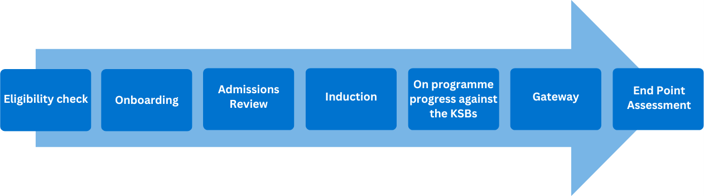
This diagram sets out the journey for your apprentice, from their initial eligibility to the final award of their apprenticeship.
Apprentice's Starting Point
Before starting training, every apprentice completes an Initial Needs Assessment (INA) or Skills Scan against the knowledge, skills and behaviours (KSBs) of the apprenticeship standard. This assessment identifies their starting point, recognises any additional support needs, and evaluates prior learning. Employers play a key role in this process and are involved in discussions with the apprentice. Following the assessment, an Individual Training Plan is developed with the Degree Apprenticeship Compliance and Support team and must be agreed and signed by all parties. The Apprenticeship Agreement must also be signed by both the employer and apprentice before the apprenticeship begins.
Once enrolled, apprentices complete an induction and begin their on-programme learning. Progress is reviewed through tripartite meetings at least every 12 weeks, monitoring achievement of KSBs, off-the-job training requirements, and any support needs. Apprentices must also meet the academic requirements of their course in line with University and programme-specific regulations.
To complete the apprenticeship, the employer must confirm the apprentice is ready for the Apprenticeship Assessment through the Gateway process, in line with the requirements set out in the assessment plan. Upon successful completion of the Apprenticeship Assessment, the apprentice receives their apprenticeship certificate. Successful completion of the degree component also results in the award of a degree certificate.
Introduction to Degree Apprenticeship and Programme team
There are many reasons why you may wish to contact the programme and/or degree apprenticeship team, ranging from Compliance requirements/learner transfers/BILs/attendance/additional support required for learners.
Please contact the Apprenticeship Compliance and Support team at degree-apprenticeships@herts.ac.uk for further guidance.
Work-based Mentor and Programme leader responsibilities
As a Work-based Mentor, your primary role is to support the apprentice’s workplace development and progression towards achieving the knowledge, skills and behaviours (KSBs) of the apprenticeship standard. You will:
- Participate in tri-partite Progress Review Meetings with the apprentice and Apprenticeship Coach (AC).
- Set and review development targets, identify workplace learning opportunities, and provide regular feedback on progress.
- Provide coaching and mentoring to help the apprentice apply and integrate their university learning within the workplace.
- Work closely with the Apprenticeship Coach to support the apprentice’s progress, wellbeing, and compliance with apprenticeship requirements.
- Confirm that the apprentice has demonstrated the required occupational competence and is ready to undertake their Apprenticeship Assessment through the Gateway process.
Mentor training sessions explaining this are held once a semester. If you have missed a session, contact your AC and they may provide you with the recording of the session.
The Programme Leader is the apprentice’s primary academic contact and is responsible for their academic success throughout the programme, including oversight of university credits, assignments, examinations, and academic progression.
You will be supported in your role by the AC for your apprentice.
What is an Apprenticeship standard?
What is an Apprenticeship Standard?
An apprenticeship standard sets out the nationally recognised knowledge, skills and behaviours (KSBs) required for occupational competence in a specific job role. Each apprentice works towards a standard developed by employer-led groups, known as Trailblazers, which defines what must be achieved to successfully complete the apprenticeship.
The degree and apprenticeship are fully integrated. The degree provides the academic knowledge that underpins the apprenticeship standard, while workplace learning enables the apprentice to develop and demonstrate the required skills and behaviours in practice.
Together, these elements support the apprentice in achieving occupational competence. All apprenticeship standards define:
- Knowledge: The underpinning theory, concepts and understanding required for the role. This is primarily developed through the degree programme and other off-the-job learning delivered by the University.
- Skills: The practical abilities and competencies required to perform effectively in the role. These are developed and demonstrated mainly through workplace experience.
- Behaviours: The professional attitudes and ways of working expected within the occupation. These are typically developed through workplace practice and professional experience.
To complete the apprenticeship, apprentices must demonstrate achievement of all the KSBs specified within the standard. Employers play a key role in supporting this development and must confirm that the apprentice has achieved the required level of occupational competence before undertaking their Apprenticeship Assessment.
Further information on apprenticeship standards and assessment plans can be found on the https://www.gov.uk/government/organisations/skills-england.
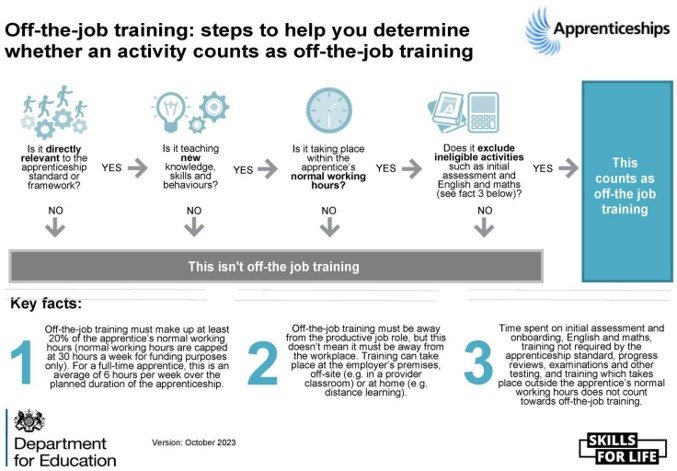
As a mentor, you can think of OTJ training as time dedicated to helping the apprentice meet their apprenticeship standard. OTJ is a statutory requirement for all apprentices in England.
OTJ hours must:
- Take place during normal working hours.
- Develop new knowledge, skills, and behaviours (KSB’s).
- Be recorded in Aptem each calendar month.
Logging requirement: OTJ activities must be logged monthly to the equivalent of once per week. Best practice would be to upload weekly.
The mentor’s role is crucial in making sure that the apprentice is accessing the necessary OTJ within their normal working hours and to take steps to protect that time. This can include lectures, online learning, simulation activities, work shadowing, mentoring, industry/field visits, learning support, and writing assignments.
Your role in Progress Review Meetings (PRM)
As a mentor, the key milestones for tracking the apprentice’s progress will take place through the tripartite Progress Review Meetings. These will be scheduled to take place every 12 weeks and recorded through Aptem.
In advance of the meeting, you will complete the Employer Mentor page on Aptem ready for discussion. Similarly, your apprentice has a page regarding their progress to complete prior to the meeting, and you may wish to have a discussion together.
The Work-based Mentor (WBM) in the review meeting has a role to:
- Inform the University on how the apprentice is progressing.
- Share any concerns about the apprentice’s progress.
- Be appraised of the apprentice’s portfolio and areas for future development.
- Advise of any future off-the-job or on-the-job training opportunities that the apprentice may benefit from.
The role of the Apprenticeship Coach (AC) at the review meeting is to:
- Co-ordinate the meeting.
- Review the apprentice’s progress and/or portfolio giving feedback and guidance.
- Share the apprentice’s academic achievement with the Work-place Mentor and any other relevant issues.
- Wellbeing check and effectiveness of wny learning or personal support in place.
- Identify future goals and timeline.
- Complete the progress review template and attribute actions as required.
- Agree date, time and venue for the next meeting.
The role of the Apprentice for review meetings is to:
- Update the portfolio and ensure OTJ training hours are up to date.
- Review learning goals and objectives.
- Reflect on their progress, sharing how they have applied off the job learning to develop new skills in the workplace.
- Prepare questions and topics for discussion and engage in goal setting.
- Work as a team to identify new goals.
Quality Assurance and Compliance
The University of Hertfordshire works with a range of external bodies to ensure apprenticeship programmes meet regulatory requirements and maintain high standards of quality. Key organisations include:
- Ofsted – responsible for inspecting and reporting on the quality of apprenticeship provision in England.
- Department for Work and Pensions (DWP) – works with the University in relation to specific apprenticeship programmes and funding arrangements where applicable.
- Office for Students (OfS) – the independent regulator of higher education in England, ensuring students receive a high-quality academic experience.
This oversight helps ensure that apprenticeship programmes remain compliant, effective, and aligned with national expectations.
Supporting you and your learners
The University has extensive resources to ensure that our apprentices can feel supported throughout their apprenticeship. Apprentices can access academic and pastoral support through their programme teams: Programme Leaders, Module Leaders, Apprenticeship Coach and Academic Skills Units.
The University offers a wide range of other support mechanisms for apprentices which the ACs or Programme Leader can provide further information about. This includes career advice and guidance, wellbeing and safeguarding, and access to the students’ union services including clubs and sports activities.
The extensive Learning Resource Centre is accessible to all apprentices as is the virtual learning environment, Studynet, where teaching materials, reading lists other learning resources and assessment information is available.
Professional and Personal Development
The University of Hertfordshire Careers and Employment Service supports apprentices throughout their studies and for up to four years after completing their apprenticeship.
Apprentices have access to the My Careers Portal, which provides personalised careers information, resources, and opportunities tailored to their individual needs and aspirations.
Through the portal, apprentices can:
- Access personalised careers information and opportunities.
- Receive CV and application support.
- Prepare for interviews and assessment activities.
- Book appointments with Careers professionals.
- Explore careers and development events.
- Access resources that support their personal and professional growth.
Apprentices also receive a monthly Personal and Professional Development newsletter, helping them build skills, confidence, and career readiness alongside their apprenticeship programme.
Supporting Your Apprentice’s Development
We encourage employers to support apprentices in engaging with personal and professional development activities alongside their day-to-day role. By taking advantage of the Careers Service and My Careers Portal, apprentices can enhance their skills, broaden their experience, and maximise the benefits of their apprenticeship journey.
Reporting complaints
Any complaints about: (i) academic issues; or (ii) non-academic issues relating to the University’s training, services or facilities, should be referred in the first instance to the First Contact at the University for consideration by the University in accordance its policies including those relating to the escalation of a complaint. Copies of the applicable policies are available from http://www.herts.ac.uk/about-us/legal/complaints-policy.
Any party may at any time contact the Apprenticeship Helpline regarding apprenticeship concerns, complaints and enquiries:
Telephone: 0800 015 0400 nationalhelpdesk@apprenticeships.gov.uk
Safeguarding, prevent and wellbeing
Safeguarding
The University is committed to ensuring that a safe and supportive environment exists for all students, staff, and visitors to the University. Our approach to safeguarding and our responsibility to report and support is outlined in this policy.
All apprentices are made aware of this policy.
The Designated Safeguarding Officer (DSO) for the University is:
Geri Ward, Dean of Students
Email: G.1.ward@herts.ac.uk
Tel: 01707 284450 (ext: 4450)
Room: Student Wellbeing, Hutton Hub, first floor
Prevent
Like all public bodies, the University has a duty to prevent students from being drawn into terrorism or violent extremism. Prevent information will form a part of the apprentice’s induction to the University.
Our Dean of Students Office is the point of contact for any concerns about an apprentice 01707 284450 (ext 4450)
Wellbeing
Apprentices all have access to central University wellbeing support offering counselling, disability and mental health services, and financial wellbeing support. For more information, please contact the service at studentwellbeing@herts.ac.uk or the online resource at https://www.herts.ac.uk/life/support-and-wellbeing.
Further Information – for information regarding the support mechanism of the university, please refer to https://ask.herts.ac.uk/
Please refer to the guidance below regarding attendance, academic regulations and student responsibilities.
University Absences
Where a learner is unable to attend a scheduled academic session, the learner should first inform, via email:
- Programme Leader/Module Leader
- Employer
- UH Absence Reporting inbox (apprenticeabsence@herts.ac.uk)
If the learner is having difficulties, they may contact their Apprenticeship Coach (AC) for further help.
Extensions
The University can offer extensions of up to 7 calendar days in agreement with the module leader (or 10 days if a relevant Study Needs Agreement is in place for the learner). This allows the learner to submit their work after the deadline without a penalty or need for a resit. For extensions longer than 7 days, the learner must apply for Exceptional Circumstances. Apprentices are encouraged to inform employers for their need to request extensions.
Please note:
- Extensions are not automatic – the learner must ask their Programme and Module Leaders for permission;
- Some assessments may not allow extensions, or may allow fewer days;
- The Programme Leader is the first point of contact regarding Extensions.
Exceptional Circumstances (ECs)
The University operates an Exceptional Circumstances (ECs) policy http://sitem.herts.ac.uk/secreg/upr/AS14.htm. Requests for ECs are made by the learner via their student record. Learners wishing to defer an assessment should submit an EC request. EC requests must be submitted no more than 15 working days after the assessment submission deadline, and at least 5 working days before the Board of Examiners. Supporting evidence should be submitted at the same time of the request. The EC team is available to support with the request at ExceptionalCircumstances@herts.ac.uk.
Fit to Sit policy
If a learner attends an exam or submits a piece of coursework, they are declaring that they are fit to do so. However, there might be circumstances which could impact their ability to understand their ill health at the time of submission or attendance. The University operates a Fit to Sit policy which covers these circumstances.
What circumstances are covered under the Fit to Sit policy?
- Where you suddenly become unwell during an examination or in-class test and elect to leave without completing the assessment.
- Where at the time of sitting or submitting the assessment concerned, you were suffering from serious ill health or other circumstances which impaired your ability to make a rational judgement as to your ability to take the assessment.
What is the time frame for Fit to Sit requests?
If your circumstances fall under the first option (becoming unwell during an exam or in-class test and electing to leave), you will need to submit your request by midnight on the calendar day of the assessment. If your circumstance falls under the second option (you were not capable of understanding your performance would be affected) you must make a request within 15 working days of the assessment submission date but no later than 5 working days before the board.
Requests for this are made by the learner via their Student Record. Click here for step-by-step guidance.
Academic Conduct
The University has strict regulations relating to Academic misconduct and assessment offences. This includes plagiarism, collusion, cheating, breaches of professional confidentiality and failure to comply with research ethics involving human participants. Employers will be informed if an apprentice is being investigated for an academic conduct offence and the outcome of the investigation as identified in the Written Agreement, Schedule 2.
Academic Appeals
An Academic Appeal is a request from a learner to the Dean of School, to review a decision made by the Board of Examiners about the following:
- Class or grade of an Award
- Mark or grade for an individual item of coursework
- Result of an original module
- Progression on to the next stage of the learner’s Programme of Study
- Entitlement to an Award
For more information on academic appeals, please visit our Ask Herts page.
Academic Support Units
Herts Academic Skills (HAS) provides free support to help you succeed in your studies. Whether you need help with academic writing, referencing, research, critical thinking, organisation, time management or English language development, we’re here to help.
Contact us Email: HAS@herts.ac.uk.
For more information on Academic support, refer to https://ask.herts.ac.uk/herts-academic-skills-has.
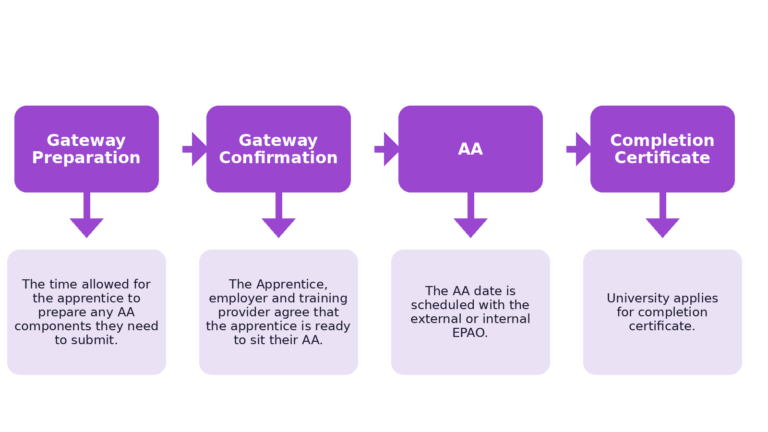
Gateway
When your apprentice reaches the end of their programme all parties need to complete the Gateway Process. Gateway is a formal documented process and provides an opportunity for you as the employer mentor, the apprentice and the University to formally agree that the apprentice has been able to evidence all the knowledge, skills and behaviours of the apprenticeship standard.
Your apprentice’s progress will be closely monitored throughout the programme – continuously working towards the Gateway requirements as identified in the Assessment Plan before they can undertake their Apprenticeship Assessment.
The employer mentor is required to confirm and sign that the apprentice has met the KSBs of the standard and any other requirements (e.g. level 2 maths and English) and is ready for the AA – effectively determining they are occupationally competent and working at or above the level on the Standard.
The University will identify these requirements on the Gateway form for the employer and support conversations to ensure a smooth path to AA. The Gateway process is often a meeting, like the progress review meeting, and a form is completed on Aptem.
For more information about the gateway requirements of your apprentice’s apprenticeship standard please see the links below.
Apprenticeship Assessment
The last element of your apprentice’s journey will be the Apprenticeship Assessment – the final stage where your apprentice will be assessed to ensure they have developed the Knowledge, Skills and Behaviours in the Standard. Specific details can be found on the programme site.
Apprentices really appreciate the support of their mentors at this crucial time in the programme.
The exact nature of the support will depend on the specific requirements of the apprenticeship – but they may need to present their projects or be interviewed on the assessment criteria – all benefitting from practice with you. The assessment landscape of the programme delivered at the University aligns with the AA strategies. This will support the learners to be able to practice the types of assessments they will experience at AA.
Aptem Assistance
Glossary
Apprenticeship Assessment
Apprenticeship Assessment is the final stage of an apprenticeship. It is an of whether the apprentice has developed the knowledge, skills and behaviours outlined in the apprenticeship standard assessment plan.
Apprenticeship Coach (AC)
This is someone employed by The University of Hertfordshire who supports the apprentice from onboarding through to EPA. You will meet every 12 weeks for progress reviews with them and the apprentice to discuss and support progress and development. They will monitor off-the-job learning, attendance, academic performance, portfolio development and readiness for gateway and passing through the EPA.
Aptem
The Apprentice Management System used to record the progress of the apprentice.
You will be sent log-in details when the apprentice starts the course as this is the place where PRMs will be recorded and you will be asked to add comments about the apprentice’s progress.
Attendance
Attendance at taught sessions (online and on campus) and progress reviews is mandatory. Apprentices will register their attendance through a recording system called JISC. Attendance will be regularly reviewed and discussed at progress review meetings and any concerns escalated.
Break in Learning (BILs)
A Break in Learning (BiL) is a temporary, planned and documented suspension of an apprenticeship programme, agreed by the apprentice, employer and training provider. A BiL is required when an apprentice is unable to participate in apprenticeship training and complete off-the-job learning for a calendar month or more. During this period, active learning ceases, apprenticeship funding is paused, and the apprentice is expected to return and complete the same apprenticeship programme.
Gateway
This is a formal documented process that provides a check point for the employer and apprentice. The employer is required to confirm and sign that the apprentice has met the KSB’s of the standard and any other requirements (e.g. level 2 Maths and English) and is ready for the Apprenticeship Assessment.
Knowledge, Skills and Behaviours (KSBs)
- Knowledge: The Standard will define the knowledge and understanding that an apprentice will need to acquire and apply in order to carry out the role effectively and become occupationally competent. The University of Hertfordshire, as the Training Provider, will provide the apprentice with the taught academic elements of their apprenticeship qualification (off the job learning).
- Skills: The Standard will define the range of skills and competencies that the apprentice needs to practise and acquire in order to do the job to a specified standard. These skills are largely acquired and practised in the workplace.
- Behaviours: The Standard will define the behaviours the apprentices will need to demonstrate in order to become occupationally competent. These are largely acquired, developed and practiced in the workplace.
Off the job (OTJ) learning
The target is a minimum of 6 hours for every working for learners who are contracted for more than 30 hours per week. This means the equivalent of approximately one day per working week, on average and over the duration of the apprenticeship should be spent gaining new KSBs. This can include lectured, online-learning, simulation activities, work shadowing, mentoring, industry/field visits, learning support and writing assignments. The majority of Off the Job training hours will be accounted for through delivery of learning at the University. this will be face to face and online.
All learners must be logging the hours and activities regularly, using OTJ log found in the Resource Centre on Aptem. Verification for OTJ hours used outside of attendance at taught sessions must also be uploaded. You will work with the AC to review this log and record of OTJ hours during progress reviews.
OTJ does not include progress reviews; training outside of paid working hours; exams; or study required in connection with achieving separate Level 2 English and Maths qualifications.
OTJ should take place within normal contracted hours. Any ‘Off the Job’ training that takes
place outside of these hours may be included as ‘Off the Job’ hours and the apprentice must
have ‘time owing in lieu’ and this must be evidenced.
On the job learning (work-based learning)
The majority of the apprentice training takes place in the workplace. It is here, in the workplace, that Knowledge is applied, and the Skills and Behaviours identified in the standard are developed until occupational competence is achieved. The University will support the apprentice and employer with this through Tripartite Progress Review Meetings.
Personal and Professional Development (PPD)
This will be discussed during Progress Review Meetings and learning have access to careers.herts.ac.uk where they will find resources on topics such as:
- Jobs and Experience
- Applications/CVs/Interviews
- Enterprise and Entrepreneurship
- Further Study
- Equality and Diversity
Portfolio
This is a collection of evidence of the apprentice’s development and course, working towards the KSBs and the professional standard. This evidence will be collected from the workplace to demonstrate KSBs in action.
Professional Standard
This is a description of an occupation. It contains an occupational profile, and describes the KSBs needed for someone to be competent in the occupation’s duties. The standards are developed by employers for occupations that meet the Institute’s current occupation criteria. Along with and end-point assessment plan and funding band, the occupational standard is a component part of an apprenticeship.
Progress Review Meeting (PRM)
Progress Review Meetings are regular planned on-programme evaluations involving the Apprenticeship Coach, the employer (usually the line manager or mentor) and the apprentice.
These meetings take place every 8-12 weeks. This is a formal, recorded process where progress towards achieving the KSBs of the standard is discussed by each party.
They will monitor off-the-job learning, attendance, academic performance, portfolio development and readiness for gateway and passing through the EPA.
Training Plan
At the start of every apprenticeship there is a three-way agreement which is called the Training Plan and includes a series of obligations, commitment and expectations between the Apprentice, their employer and the apprentice training provider.
This includes a summary of how the OTJ is calculated.
Work-based Mentor (WBM)
This should be someone from the apprentice’s employed organisation who supports development throughout the apprenticeship. They will attend progress reviews with the apprentice and AC to monitor and discuss development and achievement to the KSBs. They should meet with their apprentice at regular intervals whilst on the job and support opportunities for off-the-job learning whilst in the workplace.
We are a modern, dynamic and enterprising university, making an impact regionally, nationally and globally.
Herts. Beats Faster.